
You must have an order with a minimum of $1,000.00 to place your order, your current order total is $0.00.
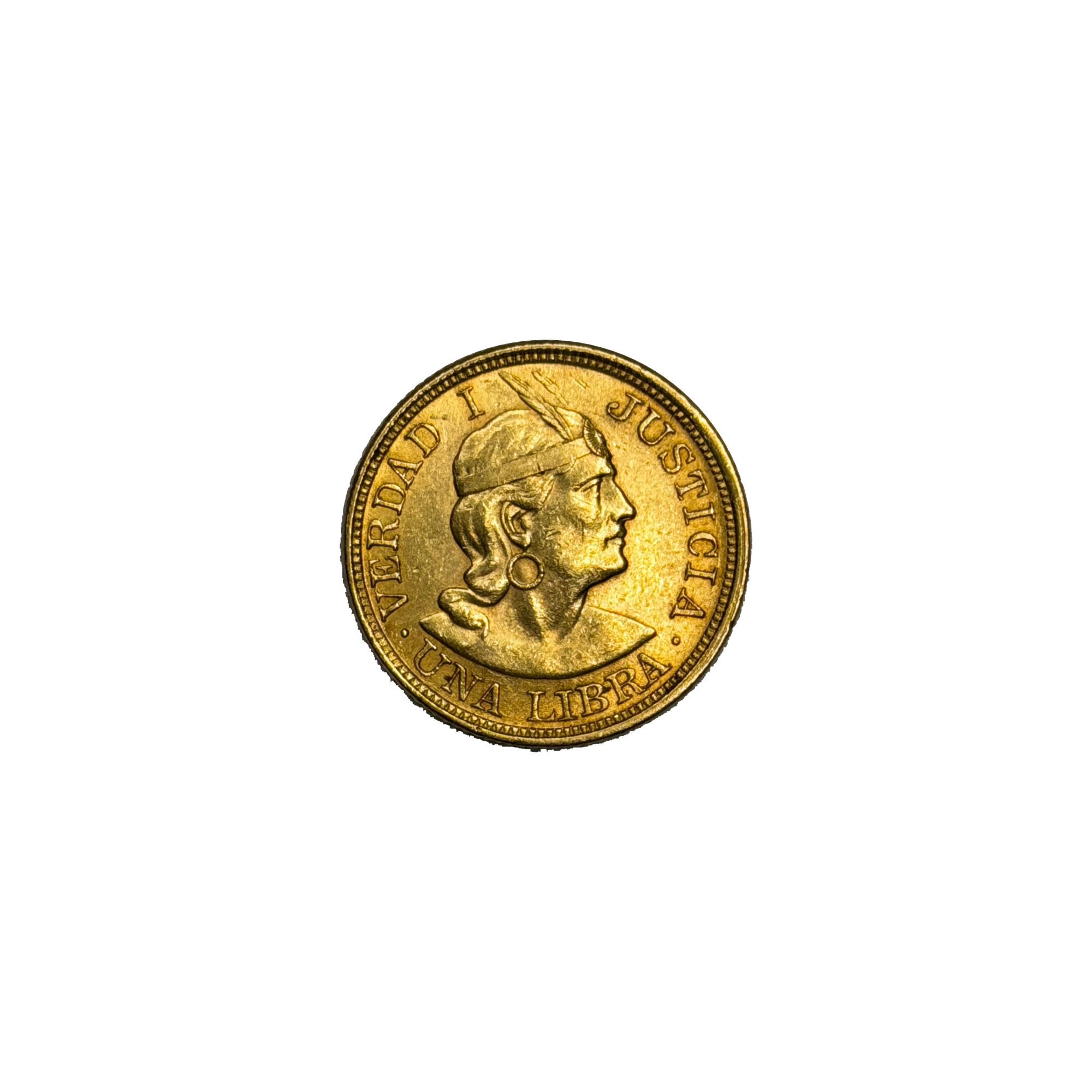
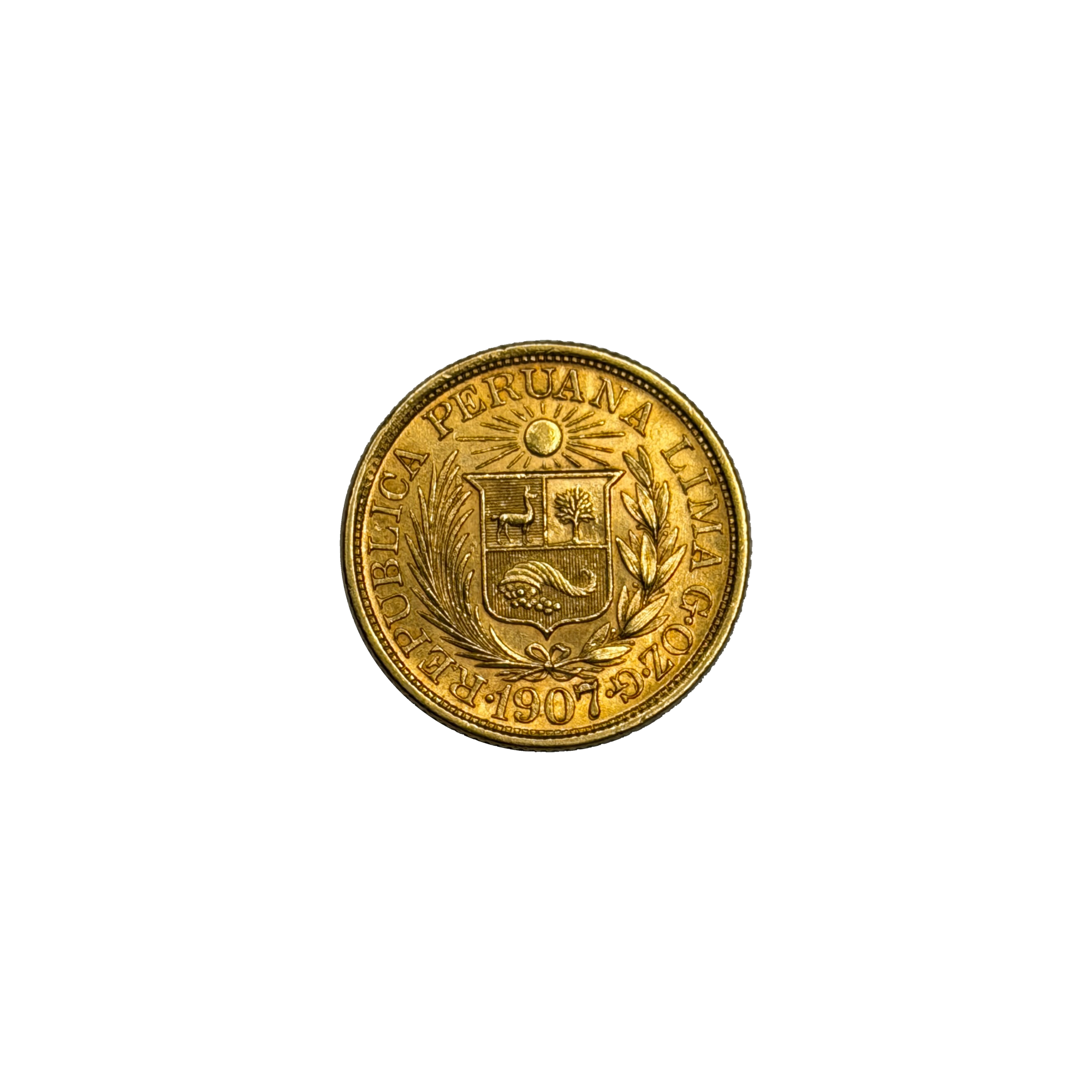
“Libra” is Spanish for pound — and the name is a precise description. When Peru organized its gold coinage at the end of the nineteenth century, it did not invent a new standard; it adopted the most trusted one on earth. The Peruvian libra, struck from 1898 into the 1930s at the mint in Lima, was deliberately minted to the exact specification of the British sovereign: 7.988 grams, .917 fine, 0.2355 troy ounces of pure gold. The result is a coin best understood as an American-hemisphere sovereign — the same gold, the same standard, and the same fractional size, carrying an unmistakably Peruvian design.
For investors, that pedigree does real work. The libra trades as historical bullion — per ounce acquisition costs comparable to modern bullion coins, tracking directly with the spot price of gold over time — while its sovereign-standard content means dealers price it off a specification the entire gold market already knows. It carries the pre-1933 designation and the associated insulation against the possibility of future government intervention, and at roughly one-quarter of a troy ounce it offers divisible negotiability: affording its owner the flexibility to liquidate positions incrementally, in amounts proportionate to the specific needs of the moment and across a variety of circumstances. Struck in quantities that are a small fraction of the more than 600 million British St. George sovereigns minted between 1817 and 1932, it also adds a layer of comparative scarcity the sovereign itself cannot offer. For investors whose priorities are a gold content struck to the sovereign’s standardized and widely recognized specification, divisible negotiability, and the comparative scarcity of a coin issued in a small fraction of the sovereign’s numbers—all for near-bullion pricing—the libra is the American hemisphere’s entry into the world’s most trusted gold coin standard.
The obverse bears one of the most distinctive portraits in classic gold coinage: an indigenous Peruvian head facing right, wearing a headband with a feather and an earring, encircled by the motto VERDAD I JUSTICIA (“Truth and Justice”) with UNA LIBRA below. In an era when nearly every gold coin in the world carried a European monarch or an allegorical Liberty, Peru placed a native American likeness on its principal gold coin — a designed statement of national identity. The reverse displays the arms of the republic — a shield bearing the vicuña, the cinchona tree, and a cornucopia, the emblems of Peru’s animal, plant, and mineral wealth — beneath a radiant sun, with the legend REPUBLICA PERUANA LIMA and the date below. The example pictured is dated 1907.
Each coin was struck at the mint in Lima to the British sovereign standard: 7.988 grams total weight, .917 fine (22-carat) gold, and 0.2355 troy ounces of pure gold. Grade range: AU. Minted 1898–1969.
Peru’s relationship with gold is as old as any nation’s — the Inca empire the Spanish encountered in the sixteenth century was the richest gold culture in the Americas, and the Lima mint, established in 1565, is among the oldest in the hemisphere. The libra belongs to the modern chapter of that history. At the close of the nineteenth century, Peru anchored its currency to gold with the libra at parity with the pound sterling — the practical recognition that in the age of the classical gold standard, British specifications were the world’s specifications. The coins circulated as working money through Peru’s export economy and traded interchangeably with sovereigns wherever the two met. A libra in the hand is thus a compact summary of four centuries: Inca gold, the hemisphere’s first mint, and the global sterling standard, in one 22-carat coin.
The libra’s liquidity argument is inherited from the most liquid fractional gold coin on earth. Because its weight, fineness, and gold content are identical to the British sovereign’s, dealers price it off the same universally documented standard — there is no unfamiliar specification to verify, no odd weight to discount. The design is immediately identifiable, the LIMA legend states its origin plainly, and the coin converts to cash wherever gold trades. Within a diversified pre-1933 holding, the libra performs exactly the role a sovereign performs — fractional size, incremental liquidation, near-bullion cost — while diversifying the holding’s issuers across hemispheres.
In 1933, FDR issued Executive Order 6102, requiring Americans to surrender their gold coin and bullion to the Treasury — but the order and the regulations that followed it exempted gold coins of recognized special value to collectors of rare and unusual coins. Subsequent clarifications by the Treasury identified pre-1933 gold coins — a classification that includes the Peruvian libra, struck from 1898 into the early 1930s — as falling within that collector classification as historical items.
Under current constitutional law, a government intervention in the gold market would be executed through the power of eminent domain — the government’s right to take private property for public use provided it pays the owner just compensation. Historic coins complicate the government’s ability to broadly establish “just compensation” or “fair value,” which was precisely the reasoning behind the original “recognized special value” exemption in 1933. That complexity, and the precedent surrounding pre-1933 gold coins, creates a notable impediment to the government’s ability to restrict them broadly — particularly compared to modern bullion, which can be valued easily and consistently at a single price. In essence, it is a bureaucratic question of whether the government would undertake the enormous task of valuing the diversity and complexity of the historic-coin genre — every coin, every date, every condition, every personal holding — and that difficulty is what insulates the owner’s legal liquidity rights in the event of capital controls.
Whether a future government intervention in private gold markets is a risk an investor assigns significant weight to is a personal judgment. The factual point is narrower: the pre-1933 status represents a layer of portfolio differentiation that this coin carries at minimal added per-ounce cost over comparable modern bullion, along with a measure of insulation for the legal liquidity rights of its owner.
Note on dates: the series continued past 1933, and USAGOLD’s pre-1933-dated pieces are the ones that fall within this classification — the date on the coin is the controlling fact.
For a more in-depth study, we invite you to read our comprehensive memorandum on this subject: Preparing for a Potential Gold Confiscation
The Peruvian libra is the sovereign standard with a story of its own — 0.2355 ounces of 22-carat gold struck at one of the oldest mints in the Americas, priced off the most recognized specification in the gold market, carrying one of the few indigenous American portraits in classic world gold coinage, and issued in a small fraction of the sovereign’s numbers. It offers the sovereign’s fractional flexibility and near-bullion acquisition costs in a coin that reaches the American market far less frequently than the sovereign itself — and rarely in quantity. No other historic gold coin delivers the sovereign’s exact standard with this blend of scarcity, artistry, and hemispheric distinction.
Pre-1933 issues (1898–1930)
| Year | Mintage |
|---|---|
| 1898 | — |
| 1899 | — |
| 1900 | 64,000 |
| 1901 | 81,000 |
| 1902 | 89,000 |
| 1903 | 100,000 |
| 1904 | 33,000 |
| 1905 | 141,000 |
| 1906 | 201,000 |
| 1907 | — |
| 1908 | 36,000 |
| 1909 | 52,000 |
| 1910 | 47,000 |
| 1911 | 42,000 |
| 1912 | 54,000 |
| 1913 | — |
| 1914 | 119,000 |
| 1915 | 91,000 |
| 1916 | 582,000 |
| 1917 | 1,928,000 |
| 1918 | 600,000 |
| 1919 | — |
| 1920 | 152,000 |
| 1921 | — |
| 1922 | 13,000 |
| 1923 | 15,000 |
| 1924 | 8,113 |
| 1925 | 9,068 |
| 1926 | 4,596 |
| 1927 | 8,360 |
| 1928 | 2,184 |
| 1929 | 3,119 |
| 1930 | 1,050 |
| Pre-1933 total (listed figures) | 4,476,490 |
Post-1933 issues (1959–1969)
| Year | Mintage |
|---|---|
| 1959 | 605 |
| 1961 | 402 |
| 1962 | 6,203 |
| 1963 | 302 |
| 1964 | 13,000 |
| 1965 | 9,917 |
| 1966 | 39,000 |
| 1967 | 2,002 |
| 1968 | 7,307 |
| 1969 | 7,307 |
| Post-1933 total | 86,045 |
Mintage figures per the Standard Catalog of World Coins, via the NGC World Price Guide. Dates NGC lists without figures are shown with a dash. Lima Mint. Where NGC lists more than one assayer for a year, the figure shown is the one NGC provides. Pre-1933 and post-1933 issues are totaled separately: only pre-1933-dated pieces carry the classification described in the Pre-1933 Advantage section.
AU
1898-1969
.2355 troy ounce
Peru
| Quantity | Wire | Card |
|---|---|---|
| 1–20 | $1,147.94 | $1,195.77 |
| 21–41 | $1,136.46 | $1,183.81 |
| 42+ | $1,124.98 | $1,171.85 |
Quantity tiers reflect the historic & fractional gold order discount (1% at $25,000+ · 2% at $50,000+ in qualifying coins). Any mix of qualifying historic coins counts toward the same order total.
Prices shown under Wire include a 4% cash discount. Card prices are the full list price. ACH bank transfer is available to established clients only. First-time orders can be paid by wire transfer or card.
Interested in gold but struggling to find the right firm?


