

You must have an order with a minimum of $1,000.00 to place your order, your current order total is $0.00.
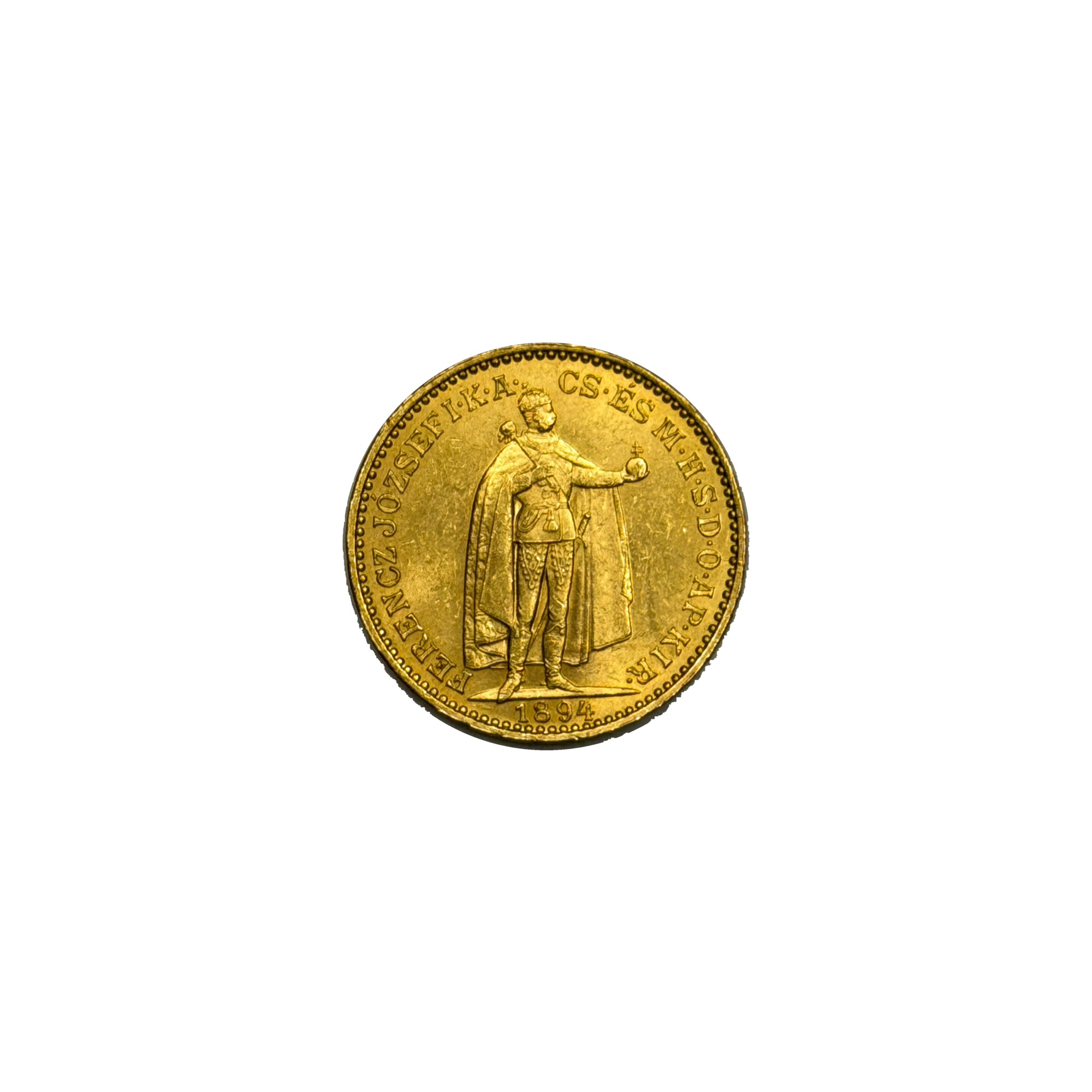
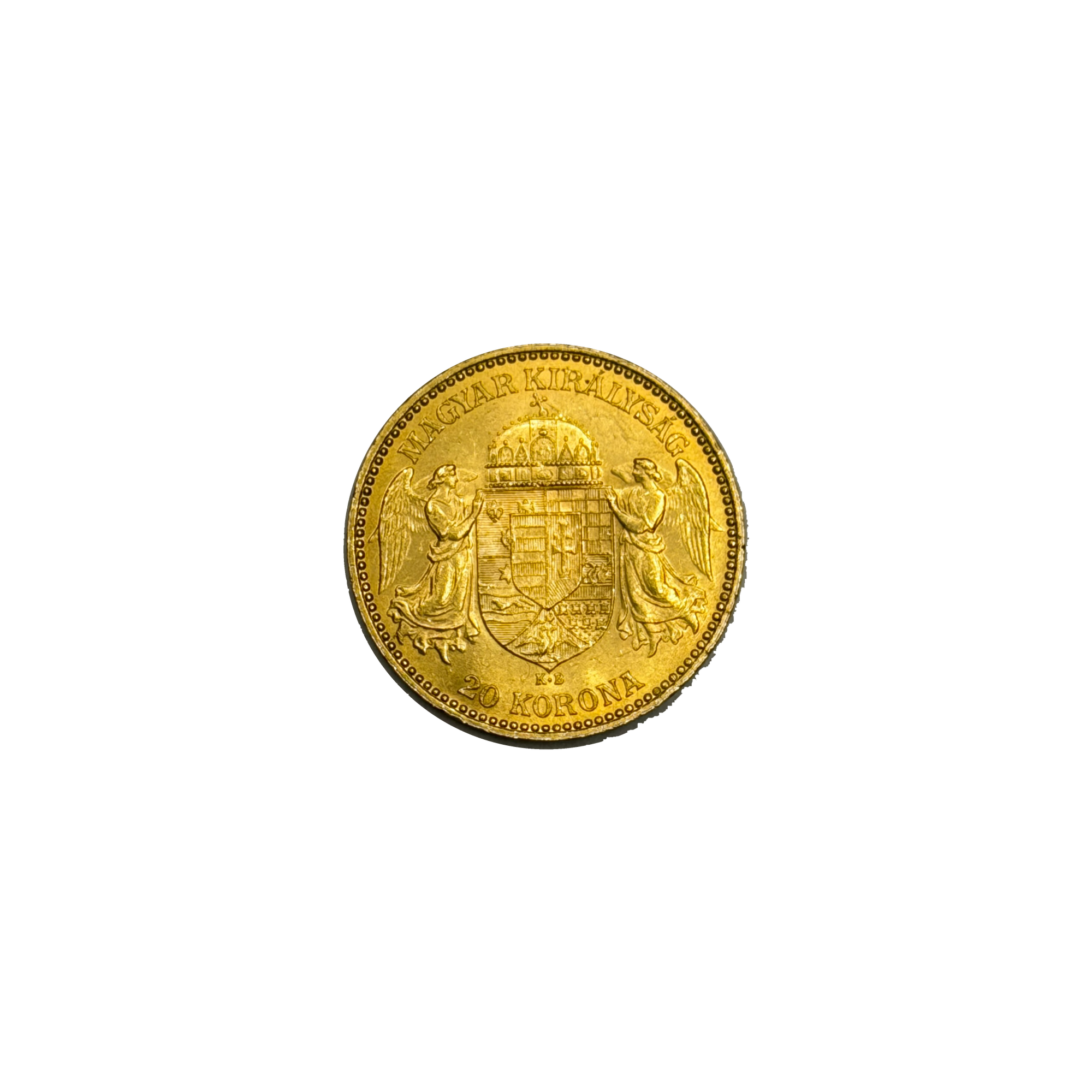
When Hungary finally crowned Franz Joseph in 1867—nineteen years into his reign—it did so on its own terms. The Compromise of that year turned the Austrian Empire into Austria-Hungary, a dual monarchy with two governments and two parallel coinages, and the Hungarian gold korona that followed made the constitutional point in metal: not a Roman-style imperial bust like Vienna’s, but the king standing full-length in the coronation robes of St. Stephen, wearing the Holy Crown that had defined Hungarian statehood for nine hundred years. The 20 Kroner, struck at the historic Kremnica mint, was the workhorse gold denomination of that coinage.
For the investor, the coin’s virtues are practical. At 0.1960 troy ounces—almost exactly one-fifth of an ounce—the 20 Kroner sits in the same size class as the Swiss 20 Franc and the French 20 Franc, the most heavily traded fractional historic coins in the market. Classified instructively as “historical bullion,” it trades at per ounce acquisition costs comparable to modern fractional bullion and tracks the spot gold price over time—and it shares a genre-wide behavior same-priced bullion never shows: during high-demand “flight-to-safety” episodes such as the 2008–09 financial crisis and the 2020–23 pandemic era, the limited supplies of historic gold produced modest premium rises across the whole genre. The fractional size provides divisible negotiability—affording its owner the flexibility to liquidate positions incrementally, in amounts proportionate to the specific needs of the moment and across a variety of circumstances. For investors whose priorities are divisible negotiability, a high state of preservation in proof-like to Uncirculated condition, and a standardized and widely recognized gold content—all for near-bullion pricing—the Hungarian 20 Kroner delivers the standard fifth-ounce package with one of the most distinctive designs in all of historic European gold.
The obverse presents Franz Joseph standing in full coronation regalia—the mantle of St. Stephen over his shoulders, the Holy Crown of Hungary on his head, the orb of state in his extended hand—surrounded by the Hungarian-language legend of his titles (FERENCZ JÓZSEF I. K. A. CS. ÉS M. H. S. D. O. AP. KIR.) with the date below. The reverse carries the crowned arms of Hungary—the Árpád stripes and the apostolic double cross on a shield supported by two hovering angels—with the inscription MAGYAR KIRÁLYSÁG (Kingdom of Hungary) above and the denomination 20 KORONA below. The K·B mint mark identifies Kremnica (Körmöcbánya), among the oldest continuously operating mints in Europe, striking coinage since the fourteenth century.
Each coin weighs 6.78 grams, is struck in .900 fine gold, and contains 0.1960 troy ounces of pure gold. Grade range: PL/UNC. Minted 1892–1915.
Franz Joseph reigned from 1848 to 1916—sixty-eight years, one of the longest reigns in European history, spanning the entire arc from the revolutions of 1848 to the middle of the First World War. The dual monarchy he accepted in 1867 was Europe’s most elaborate constitutional compromise, and its coinage was one of the few places ordinary people could see the arrangement plainly: the same monarch, the same gold standard, two entirely different national presentations. The korona system introduced in 1892 modernized the empire’s money and tied it to gold; it lasted only until the First World War dismantled first the gold coinage, then the empire itself. The 20 Kroner is working gold from the Habsburg twilight—the last decades in which Europe’s oldest ruling house presided over a great power, struck by a mint that had already been in operation for more than five centuries when the series began.
Nearly every gold coin of the classical era carries a portrait bust. The Hungarian korona series is one of the very few to present its monarch standing and in full ceremonial dress, which makes it one of the most genuinely pictorial gold coins of its century. Every element argues Hungarian continuity—the Holy Crown, the mantle, the apostolic double cross, the supporting angels—and the composition rewards close viewing in a way that profile portraits rarely do. For owners, it is the difference between holding a monogram and holding a scene.
Korona gold survived in quantity because Central European families hoarded it as trusted savings through two world wars. The coins trade today on their gold content first and their history second—which is precisely what keeps the 20 Kroner at the bullion end of the historic market and creates the value: the design and the history come at essentially no added cost. Within the fifth-ounce class it competes directly with the Swiss and French 20 Franc pieces at comparable acquisition costs, while offering a design and a historical identity that the more heavily minted types cannot duplicate.
The corona/korona family is one of the standard historic gold types in the international dealer market. Its specifications are universally documented, its trading history spans a century, and the Hungarian and Austrian issues trade as one recognized system on both sides of the Atlantic. For investors who need to convert a holding to cash quickly, the 20 Kroner performs reliably wherever gold trades, with the fractional flexibility that defines its size class.
In 1933, FDR issued Executive Order 6102, requiring Americans to surrender their gold coin and bullion to the Treasury—but the order and the regulations that followed it exempted gold coins of recognized special value to collectors of rare and unusual coins. Subsequent clarifications by the Treasury identified pre-1933 gold coins—a classification that includes the Hungarian 20 Kroner, struck in the decades before the First World War—as falling within that collector classification as historical items.
Under current constitutional law, a government intervention in the gold market would be executed through the power of eminent domain—the government’s right to take private property for public use provided it pays the owner just compensation. Historic coins complicate the government’s ability to broadly establish “just compensation” or “fair value,” which was precisely the reasoning behind the original “recognized special value” exemption in 1933. That complexity, and the precedent surrounding pre-1933 gold coins, creates a notable impediment to the government’s ability to restrict them broadly—particularly compared to modern bullion, which can be valued easily and consistently at a single price. In essence, it is a bureaucratic question of whether the government would undertake the enormous task of valuing the diversity and complexity of the historic-coin genre—every coin, every date, every condition, every personal holding—and that difficulty is what insulates the owner’s legal liquidity rights in the event of capital controls.
Whether a future government intervention in private gold markets is a risk an investor assigns significant weight to is a personal judgment. The factual point is narrower: the pre-1933 status represents a layer of portfolio differentiation that this coin carries at minimal added per-ounce cost over comparable modern bullion, along with a measure of insulation for the legal liquidity rights of its owner.
For a more in-depth study, we invite you to read our comprehensive memorandum on this subject: Preparing for a Potential Gold Confiscation
The Hungarian 20 Kroner is the fifth-ounce gold coin of the dual monarchy—a standing king beneath a thousand-year-old crown, struck at a mint older than the Renaissance, preserved in proof-like to Uncirculated condition, and priced at near-bullion acquisition costs. Among fractional historic gold coins, none pairs this level of visual and historical distinction with such practical efficiency for gold investors.
| Year | Mintage |
|---|---|
| 1892 | 1,779,000 |
| 1893 | 5,089,000 |
| 1894 | 2,526,000 |
| 1895 | 1,935,000 |
| 1896 | 1,023,000 |
| 1897 | 1,819,000 |
| 1898 | 1,281,000 |
| 1899 | 712,000 |
| 1900 | 435,000 |
| 1901 | 510,000 |
| 1902 | 523,000 |
| 1903 | 505,000 |
| 1904 | 572,000 |
| 1905 | 526,000 |
| 1906 | 353,000 |
| 1907 | 194,000 |
| 1908 | 138,000 |
| 1909 | 459,000 |
| 1910 | 85,000 |
| 1911 | 63,000 |
| 1912 | 211,000 |
| 1913 | 320,000 |
| 1914 | 176,000 |
| 1915 | 690,000 |
| Total | 21,924,000 |
Mintage figures per the Standard Catalog of World Coins, via the NGC World Price Guide. Dates NGC lists without figures are shown with a dash. Kremnica Mint (KB); official restrikes exist for certain dates.
UNC, PL
1892-1915
.1960 troy ounce
Hungary
| Quantity | Wire | Card |
|---|---|---|
| 1–25 | $958.81 | $998.76 |
| 26–50 | $949.22 | $988.77 |
| 51+ | $939.63 | $978.78 |
Quantity tiers reflect the historic & fractional gold order discount (1% at $25,000+ · 2% at $50,000+ in qualifying coins). Any mix of qualifying historic coins counts toward the same order total.
Prices shown under Wire include a 4% cash discount. Card prices are the full list price. ACH bank transfer is available to established clients only. First-time orders can be paid by wire transfer or card.
Interested in gold but struggling to find the right firm?


