

You must have an order with a minimum of $1,000.00 to place your order, your current order total is $0.00.


In 1905, President Theodore Roosevelt wrote a letter to Augustus Saint-Gaudens, the pre-eminent American sculptor of his generation, asking him to redesign the nation’s gold coins. Roosevelt had spent years frustrated by what he considered the mediocrity of American coinage compared to ancient Greek and Roman examples. He wanted coins worthy of a republic that had become a world power. Saint-Gaudens, who had spent his career creating the Shaw Memorial in Boston, the Admiral Farragut in Madison Square Park, and the standing Lincoln in Chicago — who had never, in other words, designed a coin in his life — accepted the commission.
The result was the $20 Saint-Gaudens Gold Double Eagle: widely regarded, without serious dispute, as the most beautiful coin the United States ever produced. AU/UNC examples — coins that survived more than a century of American financial history without entering commerce — can be acquired today at per ounce acquisition costs that stand at their lowest levels in years. At 8.8% above the gold spot price as of July 2026, a near-full-ounce position in one of American numismatics’ great achievements is available at effectively near-bullion pricing.
The obverse bears Saint-Gaudens’ striding Liberty: torch raised in her right hand, olive branch in her left, the rising sun at her back and the U.S. Capitol visible in the middle distance — a composition that deliberately recalled the ancient Nike of Samothrace. The reverse presents a majestic eagle in full flight above radiating sun rays, a dynamic treatment unlike any American coin before or since. The legend E PLURIBUS UNUM arcs above; IN GOD WE TRUST and the date appear below on post-1908 issues.
At 34.1mm in diameter and 33.431 grams total weight, each coin is struck from .900 fine gold and contains 0.9675 troy ounces of actual gold content — interchangeable with any recognized full-ounce gold holding, including the American Gold Eagle, the American Buffalo, or any recognized world gold coin. An investor who holds a $20 Saint-Gaudens holds the same gold content as any modern one-ounce bullion coin, alongside one of the most consequential design commissions in American history.
Augustus Saint-Gaudens was fifty-eight years old and dying of cancer when Roosevelt’s request arrived. He had never designed coinage. What he created — working from classical antiquity, from the Nike of Samothrace, from the Athenian owl tetradrachm that Roosevelt had specifically cited as his ideal — called for an ultra-high relief so deep that each coin required up to nine strikes under enormous hydraulic pressure to bring up the detail. The results, produced in tiny quantities as proofs and presentation pieces in late 1907, are now among the rarest and most valuable coins in American numismatics.
For mass production, Chief Engraver Charles Barber modified the design to a shallower relief that could be struck in a single pass. Saint-Gaudens died in August 1907, three months before his coins entered general circulation in December. The design he left behind remained in production for twenty-six years — a shorter run than many contemporaries, and one that ended not by natural obsolescence but by government mandate. Franklin Roosevelt’s Executive Order 6102 in 1933 required Americans to surrender their gold coins; many thousands of Saint-Gaudens Double Eagles were melted. Those that survive in AU/UNC condition do so because their owners chose to preserve them rather than spend them — a habit of selective savings that is both why these coins exist today and why they remain accessible at near-bullion pricing.
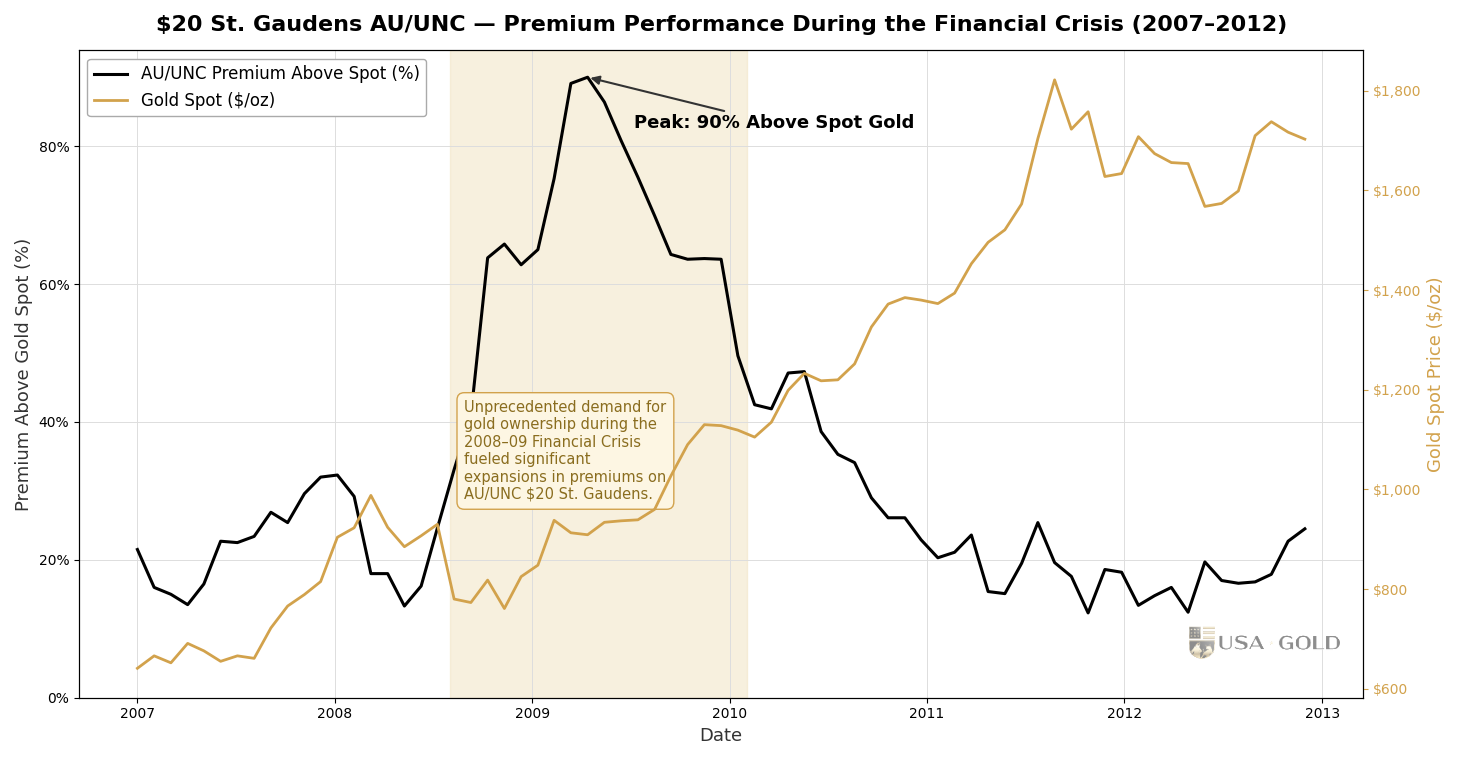
The chart above tracks the per ounce acquisition cost of the $20 Saint-Gaudens AU/UNC against the gold spot price through the 2008–09 financial crisis. In normal years, acquisition costs ran at a modest baseline above spot — consistent with what buyers expect to pay for a coin with significant gold content and historical character, but without acute demand pressure. Then Lehman Brothers collapsed. Investors seeking the security of physical gold moved into the market with a speed that overwhelmed supply, and per ounce acquisition costs on the Saint-Gaudens AU/UNC expanded to a peak of 90% above the gold spot price.
The lesson the chart teaches is not that premiums always reach 90%. It is that the relationship between per ounce acquisition costs and the gold spot price is not fixed. When demand surges, it can surge dramatically. When conditions normalize, acquisition costs return to where they are today.
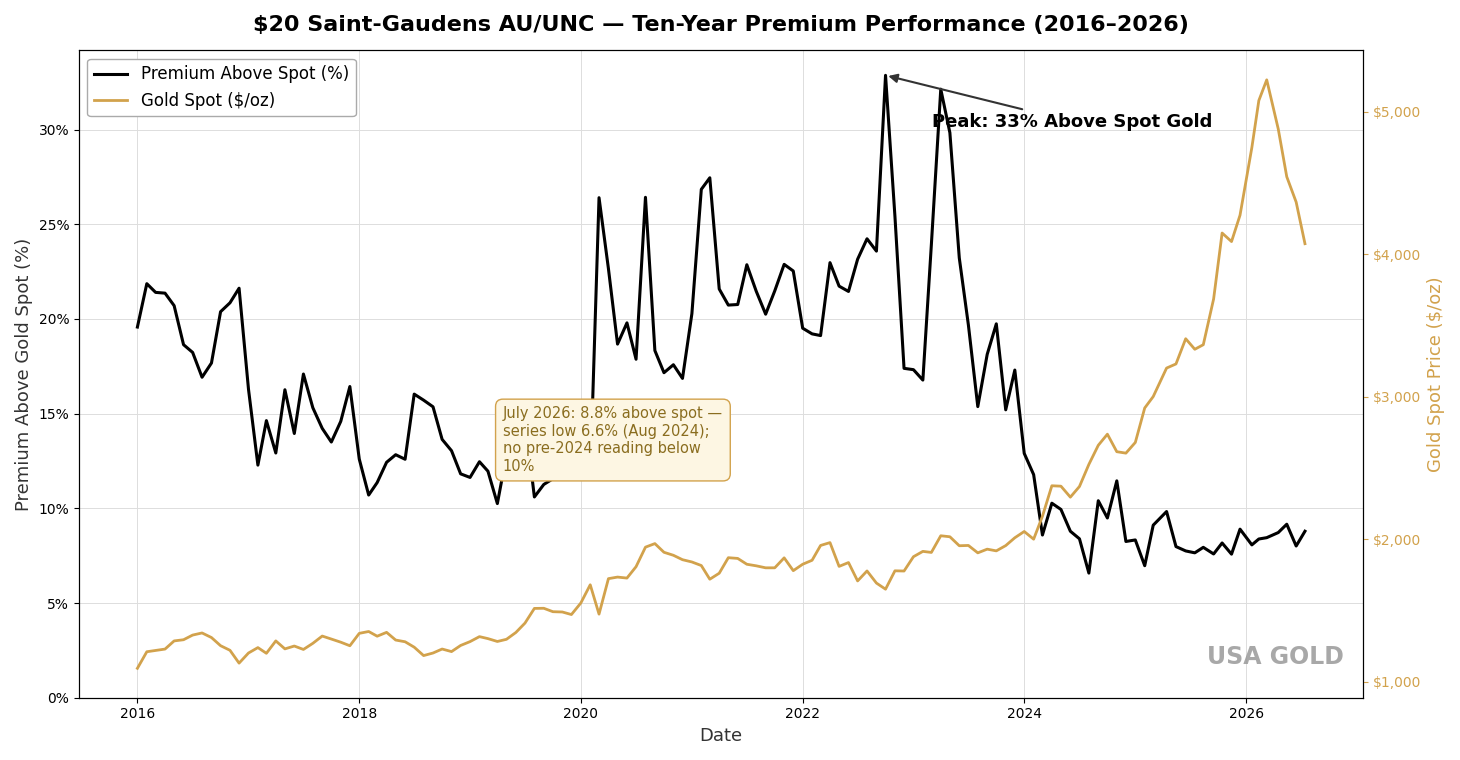
The ten-year chart captures a second premium expansion episode: the 2020–23 period, when pandemic-era economic disruption and the Federal Reserve’s unprecedented monetary expansion drove acquisition costs to 33% above spot. Since the contraction of that demand surge, per ounce acquisition costs have declined to 8.8% above spot as of July 2026 — below the 2018–2019 baseline that preceded the pandemic, a period when market conditions were unremarkable and no particular urgency existed.
For investors who recognize the pattern — modest baseline acquisition costs during calm periods, significant expansion during periods of monetary or financial stress — the current level represents a considered entry point. At 8.8% above spot, an investor acquires nearly a full ounce of gold in a coin whose premium history, made visible by the charts, speaks clearly for itself.
The $20 Saint-Gaudens entered the world in 1907. It outlasted the Panic of that same year, the Federal Reserve System (established six years after the coin’s birth), the suspension of the gold standard in 1933, the Bretton Woods system and its collapse in 1971, the inflation of the 1970s, and the financial crisis of 2008. Its gold content has survived every monetary experiment the United States has conducted in the last 118 years. The paper instruments of 1907 — the National Bank Notes, the Gold Certificates, the Silver Certificates — are museum pieces. The coin is not.
Financial history teaches two distinct lessons with uncomfortable regularity. The first: asset manias — the inflation and catastrophic collapse of prices in equities, real estate, and other speculative instruments — recur on a cycle that humbles even the most sophisticated observers. The second: the steady erosion of purchasing power through monetary expansion and the monetization of government debt continues in parallel, through different mechanisms and on a different timetable, without producing a dramatic collapse but accumulating nonetheless. The possession of gold coins like the $20 Saint-Gaudens AU/UNC in a well-constructed portfolio can insulate an investor against both — the panic that arrives suddenly and the debasement that accumulates slowly — just as it has done for millennia.
Learn More:
AU, UNC
1907 – 1932
.9675 troy ounce
United States
| Quantity | Wire | Card |
|---|---|---|
| 1–5 | $4,476.77 | $4,663.30 |
| 6–10 | $4,432.00 | $4,616.67 |
| 11+ | $4,387.23 | $4,570.03 |
Quantity tiers reflect the historic & fractional gold order discount (1% at $25,000+ · 2% at $50,000+ in qualifying coins). Any mix of qualifying historic coins counts toward the same order total.
Prices shown under Wire include a 4% cash discount. Card prices are the full list price. ACH bank transfer is available to established clients only. First-time orders can be paid by wire transfer or card.
Interested in gold but struggling to find the right firm?


MS62
1907 – 1932
.9675 troy ounce
United States
PCGS or NGC (PCGS pictured)
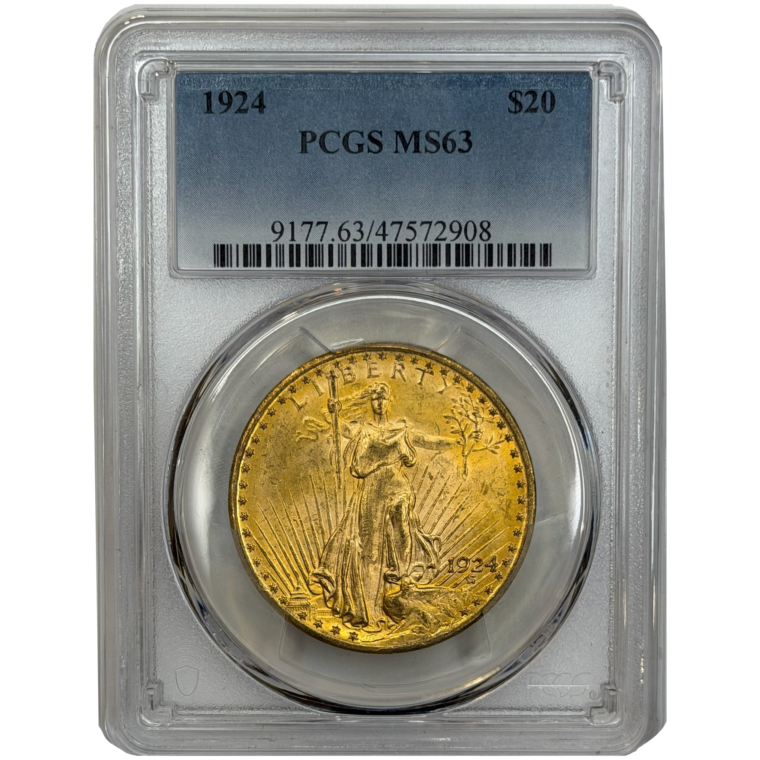
MS63
1907 – 1932
.9675 troy ounce
United States
PCGS or NGC (PCGS pictured)
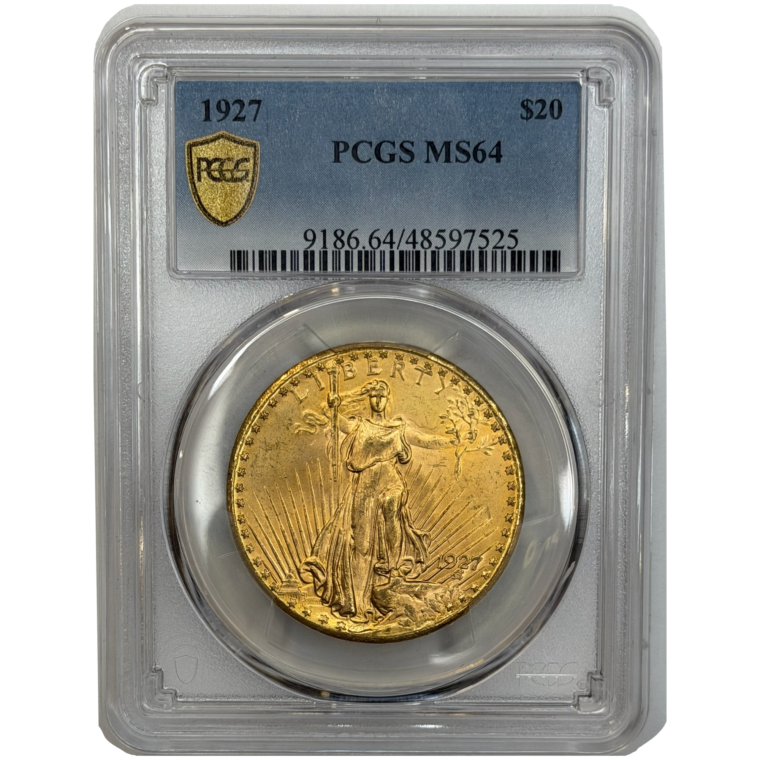
MS64
1907 – 1932
.9675 troy ounce
United States
PCGS or NGC (PCGS pictured)

MS65
1907 – 1932
.9675 troy ounce
United States
PCGS or NGC (PCGS pictured)


