
You must have an order with a minimum of $1,000.00 to place your order, your current order total is $0.00.
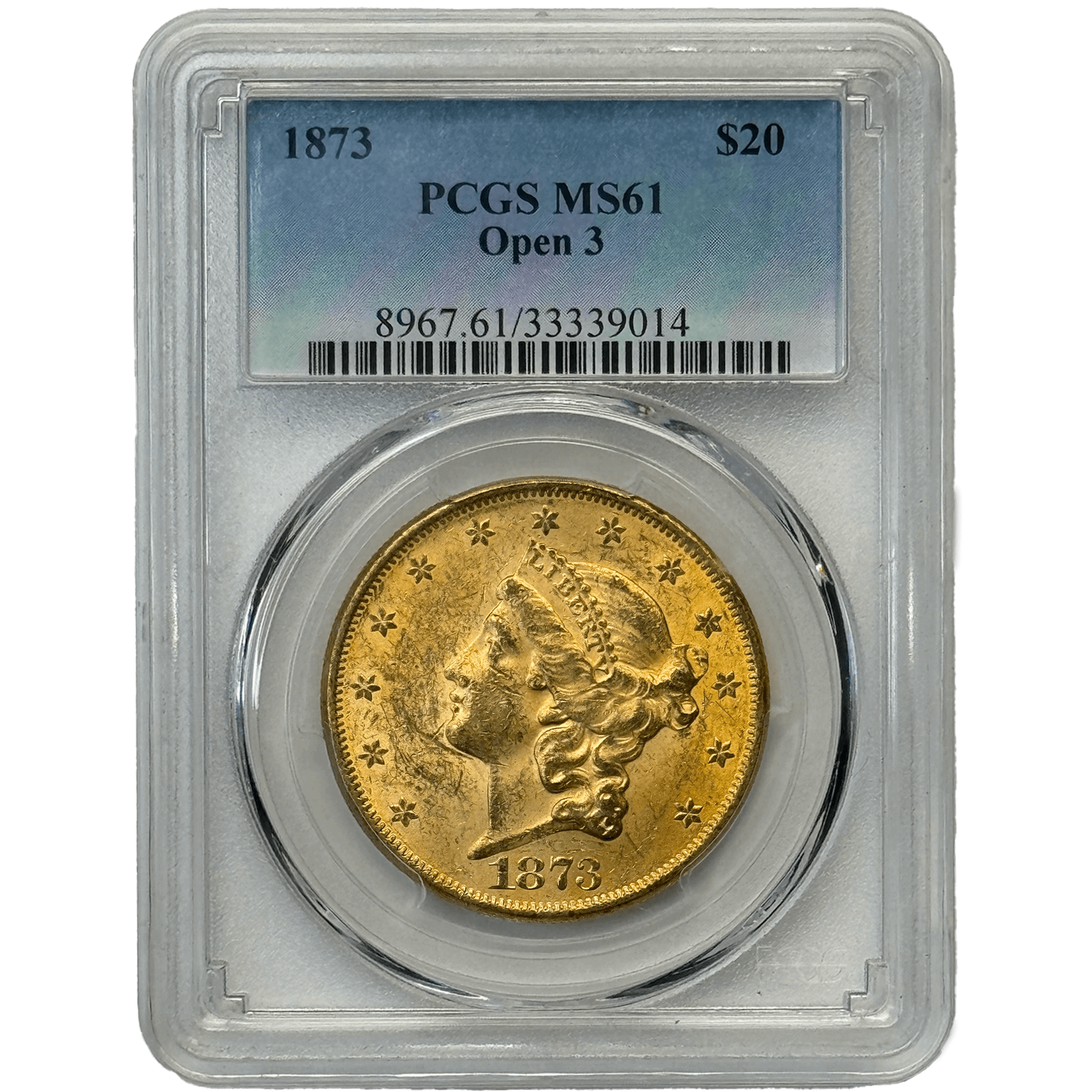
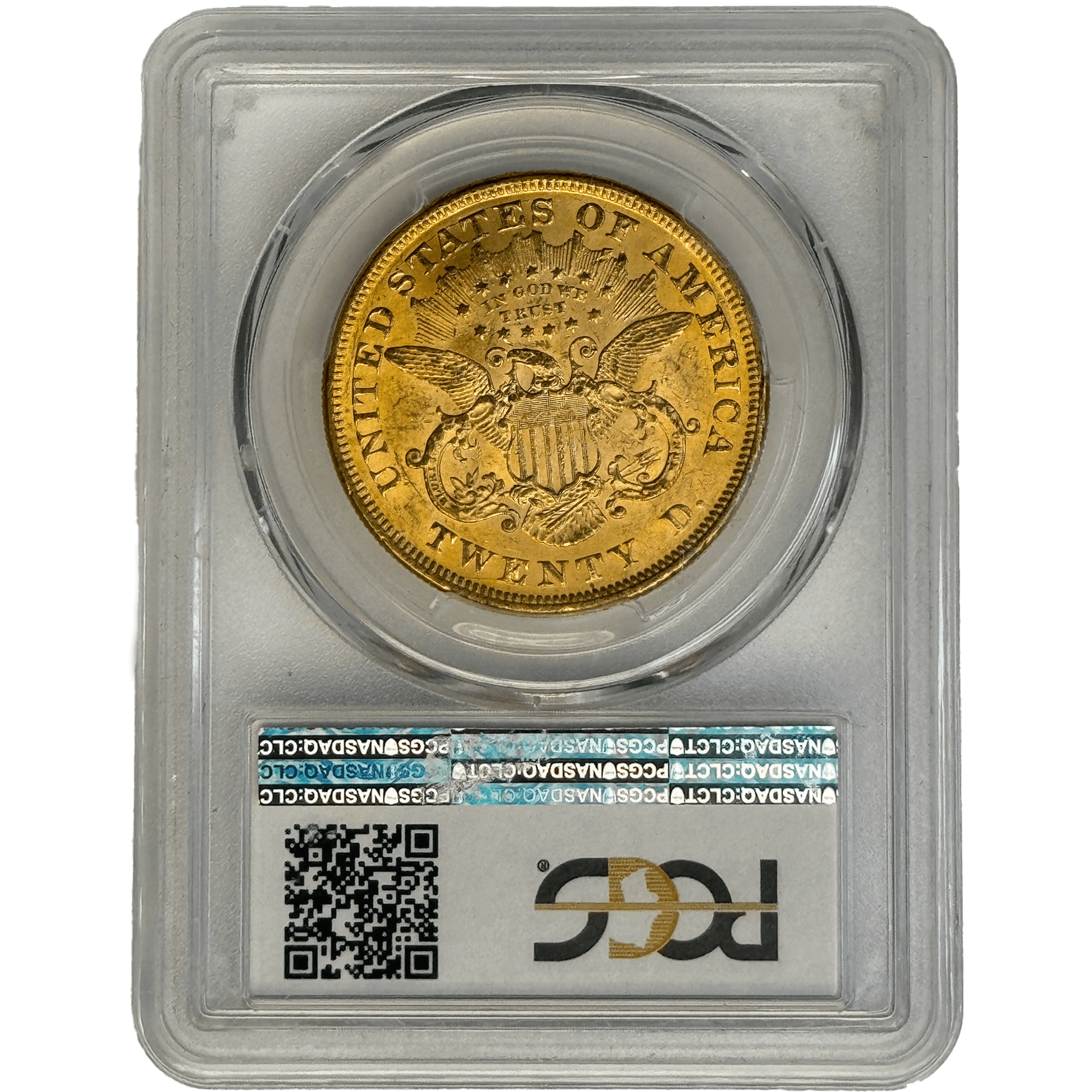
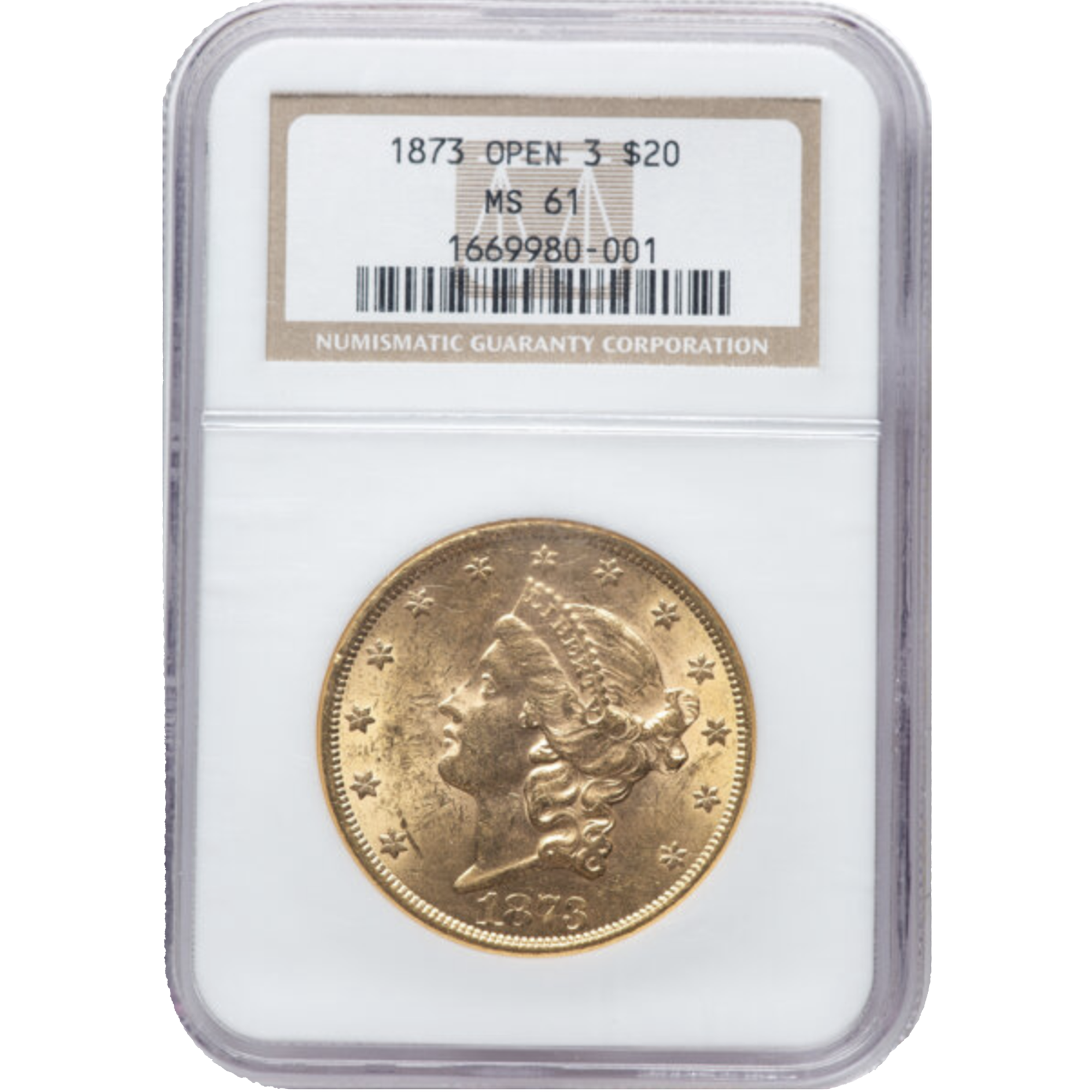
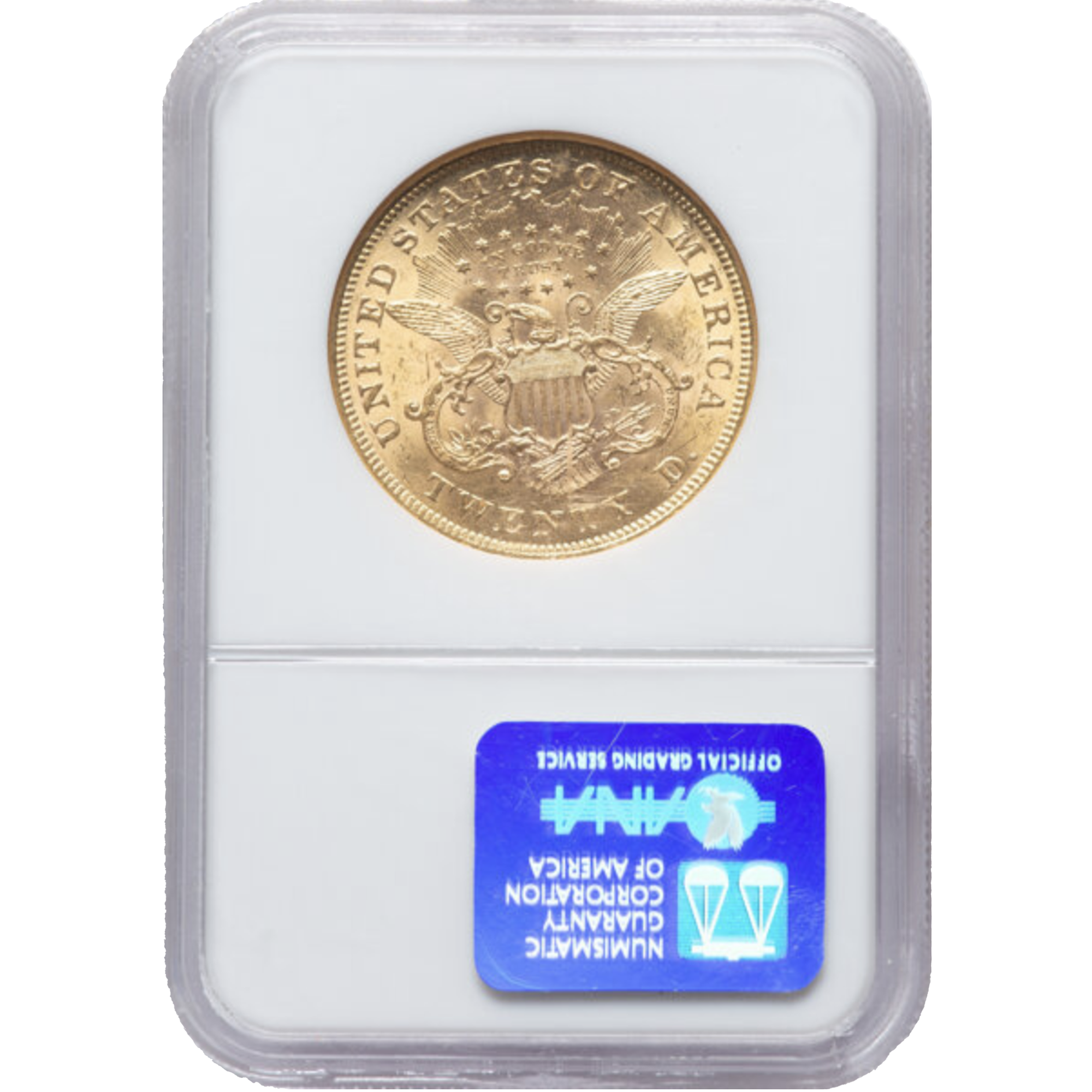
The 1873 Open 3 is the Philadelphia Mint’s principal Double Eagle of that year, and one of the most accessible entry points into the short-lived Type 2 series. Early in 1873 the Mint’s dies carried a “Closed 3” whose knobs sat so near each other that the digit read as an 8; Chief Coiner A. Loudon Snowden objected, new dies were cut with an “Open 3,” and the majority of Philadelphia’s 1873 output of 1,709,800 pieces was struck from them. The result is a Type 2 date available in Mint State in meaningful numbers, at a price that sits far closer to a common Type 3 than to its true supply.
Classified instructively as “historical bullion,” the $20 Liberty primarily tracks the spot price of gold over time, akin to a contemporary bullion instrument. That said, the series also experiences periods of premium expansion, typically during high-demand “flight-to-safety” episodes like the 2008–09 financial crisis and the pandemic. A certified MS61 Type 2 layers three further advantages on that base: a finite, fully documented certified population; the scarcest of the three Liberty design types; and an independent guarantee of grade and authenticity from PCGS or NGC. All told, it is arguably one of the better-positioned coins in the historic U.S. gold catalog for asset-preservation and safety-net-oriented investors who want a measure of upside beyond the gold price alone.
This coin was struck in the year Congress passed the Coinage Act of 1873, the law that quietly ended the free coinage of silver and placed the United States on a de facto gold standard. Silver interests would spend the next quarter century denouncing it as the “Crime of ’73,” and the Double Eagle became the physical expression of the monetary system that act created. The Type 2 series as a whole belongs to Reconstruction and westward expansion, the eleven years between the end of the Civil War and the nation’s Centennial, and the 1873 Philadelphia issue sits squarely in the middle of it.
James B. Longacre’s Liberty wears a pearl-bordered coronet inscribed LIBERTY, encircled by thirteen stars for the original colonies. The reverse presents the heraldic eagle with shield, olive branch, and arrows—and, on the Type 2, the motto IN GOD WE TRUST in the scroll above the eagle’s head. It is a restrained, formal design, an assertion that the young republic’s largest gold coin belonged in the same company as the great coinage of Europe.
Mint State 61 means the coin never entered circulation. Where an AU/UNC coin carries a trace of friction on the cheek and the coronet from brief commercial handling, an MS61 example shows none: the coronet crisp, the stars fully resolved, the fields carrying their original mint luster under the ordinary contact marks a nineteenth-century coin acquired in a Mint bag. Each coin is certified and sonically sealed by PCGS or NGC, so the grade, the date, the variety, and the authenticity are independently guaranteed rather than left to the eye of the buyer or the seller.
Our AU/UNC $20 Liberty is the workhorse of the historic-gold genre: near-bullion pricing, deep liquidity, and a documented record of premium expansion. The MS61 Type 2 is the same coin one step further along each of the axes investors care about, at a per ounce acquisition cost that remains a fraction of what the MS63 and MS64 certified tiers command.
Coins in this offering are a mix of PCGS- and NGC-certified examples. Both services are universally recognized by dealers and auction houses worldwide, and both guarantee the grade on the holder. Specific holder generation and label style vary by coin.
The $20 Double Eagle is, alongside the British sovereign and the 20 Franc, one of the foundational instruments of the gold-standard era. Dealers across North America and Europe recognize it on sight, its specifications are universally documented, and its trading history is deep enough that bid-ask spreads remain tight across international markets. A PCGS or NGC holder adds a second layer: the coin can be sold sight-unseen against the certification, which is how the wholesale certified market already trades.
In 1933, FDR issued Executive Order 6102, requiring Americans to surrender their gold coin and bullion to the Treasury—but the order and the regulations that followed it exempted gold coins of recognized special value to collectors of rare and unusual coins. Subsequent clarifications by the Treasury identified pre-1933 gold coins like the $20 Liberty as falling within that collector classification as historical items.
Under current constitutional law, a government intervention in the gold market would be executed through the power of eminent domain—the government’s right to take private property for public use provided it pays the owner just compensation. Historic coins complicate the government’s ability to broadly establish “just compensation” or “fair value,” which was precisely the reasoning behind the original “recognized special value” exemption in 1933. A certified, date-specific coin like this one sits at the far end of that complexity: every date, every variety, every grade carries its own value, and that difficulty is what insulates the owner’s legal liquidity rights in the event of capital controls.
Whether a future government intervention in private gold markets is a risk an investor assigns significant weight to is a personal judgment. The factual point is narrower: the pre-1933 status represents a layer of portfolio differentiation that this coin carries at minimal added per-ounce cost over comparable modern bullion, along with a measure of insulation for the legal liquidity rights of its owner.
For a more in-depth study, we invite you to read our comprehensive memorandum on this subject: Preparing for a Potential Gold Confiscation.
The 1873 Open 3 offers the investor a certified, never-circulated Type 2 Double Eagle from the year the United States committed itself to gold, at a premium far closer to bullion than its supply would suggest. For investors whose priorities are a certified grade, the scarcest of the three Liberty types, and a Philadelphia date available in Mint State in workable quantity, the 1873 Open 3 MS61 is the natural first step up from the AU/UNC Double Eagle. No other gold coin can boast this unique combination of so many notable advantages for gold investors.
Learn More:
Investing in $20 Liberty Gold Coins: Building Date Runs
Pre-1933 US Gold Coins Investment Guide: $10 & $20 Liberty Complete Analysis
Pre-1900 $20 Liberty Gold Coins: Scarce MS63 $20 Liberty Offered at Common Date Premiums
Historic Low Premiums Make Pre-1933 Gold Coins a Smart Investment
Outshining the S&P 500: Why Pre-1933 Gold Coins Could Boost Your Return
MS61
1873
.9675 troy ounce
United States
Prices shown under Wire include a 4% cash discount. Card prices are the full list price. ACH bank transfer is available to established clients only. First-time orders can be paid by wire transfer or card.
Interested in gold but struggling to find the right firm?


